The Key Takeaway
Backflow prevention protects drinking water by stopping contaminated water from flowing back into the potable supply. The required protection depends on the building, plumbing system, and hazard level.
In Ottawa, one of the most commonly overlooked requirements we see is annual testing of registered backflow devices. Installing a device is only the first step—ongoing testing and maintenance are essential to ensure it continues to work properly.
Requirements vary by municipality, but for commercial, institutional, industrial, and multi-residential properties across Ottawa and Eastern Ontario, backflow prevention should be treated as an ongoing part of responsible building management.
Table of Contents
Why is backflow prevention important for commercial buildings?
What are the backflow prevention requirements in Ontario?
What types of backflow protection does a building need?
What types of backflow preventers are commonly used?
Do backflow preventers need to be tested?
What happens if a backflow preventer fails its test?
Who is responsible for maintaining backflow protection?
How can DILFO help with backflow prevention?
Is your building’s backflow protection up to date?
Your building’s plumbing system has a fairly simple job: move water where it belongs, in one direction. When it doesn’t, things can get complicated.
Backflow occurs when water from a private plumbing system flows backward into the potable water supply. In a commercial or institutional building, that water could contain chemicals, glycol, process water, or other substances that should never enter the drinking water system.
Backflow prevention helps stop that from happening.
You may have received a notice from your municipality requiring a backflow preventer, or you may already have one that needs its annual test. Either way, many building owners and facility managers don’t know where to start.
The right protection depends on the building, the systems connected to its water supply, the potential hazard, and the requirements of the local municipality or water authority.
How does backflow happen?
Backflow happens when pressure changes cause water to move in the wrong direction—from a building’s private plumbing system back toward the municipal water supply. Two conditions can create this pressure reversal: back pressure, when building pressure increases, and back siphonage, when municipal pressure drops.
- Back pressure: When pressure within a building’s plumbing system becomes greater than the pressure in the municipal water supply. A building may have equipment operating at a higher pressure than the incoming water supply, and pressure difference can force water to flow in the wrong direction.
- Back siphonage: When a sudden reduction in the municipal water supply pressure causes water to flow backward from a building’s plumbing system. Events such as water main breaks or significant water demand can cause pressure changes that create this risk.
Why is backflow prevention important for commercial buildings?
Backflow prevention protects the public drinking water supply from potential contamination caused by cross-connections within a building’s plumbing system. The risk is particularly important where potable water connects to equipment or systems containing chemicals, treated water, or other potential contaminants:
- Boilers and hydronic systems
- Cooling towers and chilled water systems
- Fire protection
- Irrigation
- Process equipment
- Commercial kitchens
- Healthcare equipment
- Chemical feed systems
The risk isn’t necessarily the equipment itself. It’s what could enter the drinking water supply if a cross-connection exists and water flow reverses.
What are the backflow prevention requirements in Ontario?
Backflow prevention requirements are determined by applicable provincial requirements, CSA standards, and the rules of the municipality or water authority responsible for the local water system. Requirements can vary depending on the jurisdiction, building type, and hazard.
In Ottawa, the City’s Backflow Prevention Program requires appropriate protection and annual testing for applicable properties and registered devices. Building owners should confirm current requirements with their local municipality or water authority.
What types of backflow protection does a building need?
The appropriate protection depends on the potential hazard, plumbing configuration, and applicable local requirements. Protection may be installed at individual pieces of equipment, within specific areas, or where water enters the building.
- Point-of-use: Protects an individual piece of equipment or potential source of contamination.
- Area or zone: Protects a specific area with a higher hazard.
- Premise isolation: Protects the municipal water supply at the building’s water entry point.
Buildings may require more than one type of protection, and different levels of protection could be used throughout a building depending on the systems and risks.
What types of backflow preventers are commonly used?
Different backflow prevention assemblies provide different levels of protection, so the appropriate device must be selected based on the hazard and application. Common assemblies include Double Check Valve Assemblies and Reduced Pressure Principle assemblies.
- DCVA: Commonly used for moderate-hazard applications.
- RP assembly: Provides a higher level of protection and is commonly used for severe-hazard applications.
Do backflow preventers need to be tested?
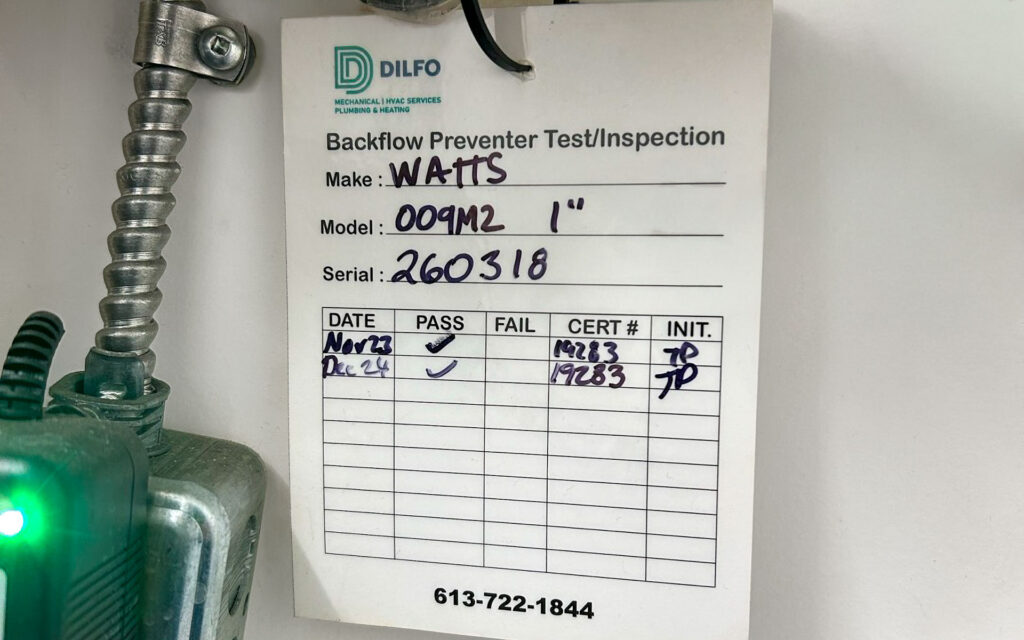
Yes. Many testable backflow prevention assemblies require annual testing because their internal mechanical components can wear, become obstructed, or fail over time. Testing confirms that the assembly is operating properly and identifies devices that require cleaning, repair, or replacement.
One of the challenges we see is that a backflow preventer can have a problem without any obvious sign for building staff. This is why regular testing is so important.
At DILFO, dirt and debris are among the most common reasons we see backflow preventers fail testing. Debris can interfere with the internal components and prevent the assembly from operating properly.
What happens if a backflow preventer fails its test?
A failed backflow preventer should be repaired or replaced and then retested according to applicable requirements. The appropriate solution depends on the condition of the device, the cause of the failure, and whether it remains suitable for the system it protects.
At one large site we test and service annually, more than 30 backflow preventers are affected by hard water and debris, causing many of the devices to fail their initial tests. Our team typically disassembles and cleans the affected assemblies, replaces the necessary components with rebuild kits, and retests them before returning them to service.
Where debris is a recurring problem, we’ve also installed strainers upstream of backflow preventers to help reduce the material entering the assembly in the first place.
Testing identifies the problem; proper maintenance can help address the underlying cause.
Who is responsible for maintaining backflow protection?
Building owners are generally responsible for ensuring required backflow protection is installed, maintained, tested, and kept in compliance with applicable requirements. This can include scheduling testing, addressing failed devices, maintaining records, and meeting reporting deadlines.
Backflow protection should be reviewed when a building undergoes significant plumbing or mechanical changes, when equipment is replaced, when a device repeatedly fails testing, or when the building’s use changes.
How can DILFO help with backflow prevention?
DILFO’s plumbing and mechanical teams can help commercial, institutional, industrial, and multi-residential clients install, replace, and maintain backflow protection. Because our teams work across interconnected plumbing and mechanical systems, we can consider backflow protection alongside the equipment and piping it serves.
For existing buildings, our approach starts with understanding what’s actually there, how the systems operate, and what the building needs today—not simply what may have been installed decades ago.
Is your building's backflow protection up to date?
Backflow prevention is an important part of responsible building management, particularly where plumbing systems connect to equipment or processes that could introduce a potential hazard. Staying current with testing and maintenance helps building owners meet applicable requirements and protect the drinking water supply.
Contact us today to discuss your commercial or institutional plumbing and backflow prevention needs.
Backflow prevention FAQs
How does the Ontario backflow prevention program protect public health from water contamination?
The Ontario backflow prevention program helps protect public health by identifying potential cross-connections and requiring appropriate protection to prevent contaminated water from entering the potable water supply. Regular backflow testing helps confirm that mechanical devices continue to function properly and supports ongoing hazard prevention.
How often should a backflow test be performed to prevent water contamination?
Many testable backflow prevention devices should be tested annually, although requirements can vary by municipality and application. Testing confirms that the device is functioning as intended and can identify problems that could otherwise allow water contamination through backflow.
What are the consequences of backflow for public health in industrial settings?
Backflow in an industrial plumbing system can introduce chemicals, process water, or other hazardous substances into the potable water supply. Depending on the hazard, this can pose a serious risk to public health. Appropriate backflow protection and regular testing are important parts of hazard prevention.
What is included in a standard plumbing inspection for multi-residential buildings?
A standard plumbing inspection may include reviewing water supply and drainage systems, fixtures, valves, pumps, equipment connections, leaks, and visible signs of deterioration. For multi-residential buildings, the inspection may also identify potential cross-connections and backflow risks. The scope depends on the building and the purpose of the inspection.
How do HVAC contractors ensure backflow protection in a commercial plumbing system?
Mechanical and plumbing professionals ensure backflow protection by identifying equipment connected to the potable water supply, assessing potential hazards, and installing the appropriate protection. For systems such as boilers, hydronic equipment, cooling towers, and other mechanical equipment, backflow protection should be considered as part of the overall commercial plumbing system rather than as a standalone component.